
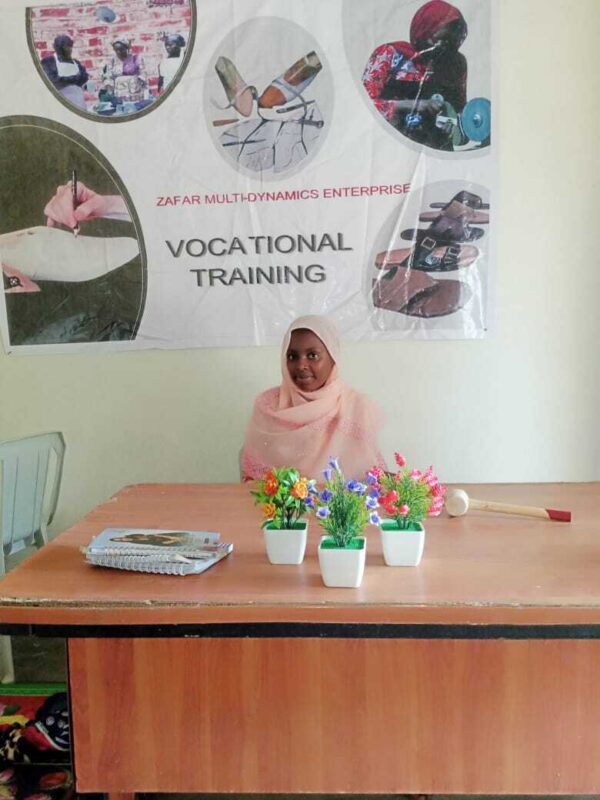
Binta’s shoemaking training has empowered hundreds of women to put their best foot forward, enabling grassroots change one step at a time.
Binta runs shoemaking courses for women in underserved communities in Nigeria, equipping them to earn an independent income by making and selling shoes. Alongside running her own footwear business, Binta, 28, has trained hundreds of women so far, many of whom have also gone on to launch their own businesses, in a chain reaction of empowerment.
With support from our Sustainable Enterprise Challenge programme, Binta has now enhanced and expanded her training hub to reach even more women.
‘Over 200 women have been trained so far, with many already producing and selling their own shoes,’ Binta explains. ‘I am most proud of seeing women who once had no income now running small businesses and contributing to their households.’
Extending opportunity
Growing up, Binta saw many women in her community struggle with poverty and unemployment, with limited skills and opportunities for earning. Despite her own modest resources, she became determined to change this.
Binta’s startup company, Zafar Multi-Dynamics Enterprise, specialises in footwear, alongside hair and body products. Her own entrepreneurial journey strengthened her resolve to share practical knowledge and opportunities with others, upskilling them to start their own ventures.
With a particular focus on reaching widows, young mothers and those who left school early, Binta’s shoemaking courses comprise both technical skills, such as cutting patterns, and business guidance, covering topics from branding to
marketing.
‘I developed this programme to tackle the rising unemployment among vulnerable women and to give them practical skills they can use to support themselves and their families,’ Binta explains.
Supporting women's entrepreneurship
Self-employment and entrepreneurship are essential earning pathways for many young Nigerians, especially women. With greater household and care responsibilities than men, and less access to education, training, finance and transport, women face many additional challenges in finding paid work.
World Bank figures highlight that more than three quarters of women in Nigeria are in the workforce, but almost 90% of them are self-employed. Women’s businesses have enormous potential to drive prosperity, but face many obstacles to growth. On every front, from business and technical skills training to access to finance for investment, female entrepreneurs face many more barriers than their male counterparts.
Our Sustainable Enterprise Challenge programme, run with the British Council and local partners such as Octoville Development Company, aims to support aspiring young entrepreneurs to develop or grow their business, so they can create jobs for themselves and others. In 2025, 480 young people like Binta took part in the programme, 60% of them women.
Sharing the skills for success
‘I joined The King’s Trust programme to strengthen my leadership, business structure, and impact strategy,’ Binta explains. ‘The skills I gained in entrepreneurship, planning, and community engagement have enabled me to enhance the way I manage my vocational hub and support the women I train.
Before joining, I was facing significant challenges such as limited funding, inadequate space, and a lack of machinery and technical knowledge. The programme helped me address these gaps and operate more confidently and professionally.’
As well as empowering Binta to overcome these operational challenges, the programme also equipped her with the skills to refine her course content and approach, and to expand her outreach activities to reach even more women.
Binta has also embedded her learning from the programme into her own training sessions, supporting her trainees to better understand critical business issues such as pricing, customer relations and long-term sustainability.
Binta’s own long-term vision for her training venture sees it continue to extend its reach and impact. ‘I hope to expand the programme to more communities and create a larger production hub that will help even more women become financially independent,’ she says.