
Corporate-NGO Partnerships Are Being Redefined in the Push for Measurable Impact
Corporate social responsibility is no longer judged solely by the programmes a company supports. Stakeholders now want to see evidence of lasting impact and a clear link between social investment and real-world outcomes.
The conversation is shifting from what organisations say they are doing to what actually changes as a result of their involvement.
This shift is most visible in partnerships between corporates and specialist organisations working directly with young people facing barriers to employment, education and training. Through collaborations with organisations such as The King’s Trust International, companies are increasingly exploring how social impact can be embedded within business strategy, rather than treated as a separate strand of activity.
Founded in 2015 by His Majesty King Charles III, The King’s Trust International builds on more than 50 years of experience through The King’s Trust in the UK. Established to address the global challenge of youth unemployment, KTI now works with local partners in more than 20 countries to deliver programmes in education, employability and entrepreneurship. Its mission is to help young people learn, earn and thrive by equipping them with the skills, confidence and opportunities needed to access meaningful work.
To date more than 150,000 young people have moved into meaningful work, with three-quarters entering employment within six months and 90% reporting stronger core skills as a result of their participation.
Looking ahead, KTI’s 2026–2035 strategy, Generation Potential, sets an ambition to support one million young people worldwide, scaling impact through deeper, more strategic partnerships with businesses, governments and local organisations.
Against this backdrop, perspectives from Karen Zacca – Director of Operations at Sandals Foundation, Luke Manning – Head of the LSEG (London Stock Exchange Group) Foundation and Carmel McConnell MBE – Director Social Impact and Sustainability at World Wide Technology (WWT), all partners working alongside The King’s Trust International, offer insight into what effective CSR looks like in practice. While operating across very different sectors, all three emphasise the same core themes: long-term commitment, practical action and partnerships that deliver measurable outcomes for young people.
The partnerships themselves span different areas of KTI’s work. LSEG Foundation supports Project Lehar in India, helping adolescent girls from marginalised communities build educational, vocational and life skills. Sandals Foundation supports the Team programme in Saint Lucia, delivered by the Royal Saint Lucia Police Force, which equips at-risk young people with employability, confidence and personal development skills. World Wide Technology sponsors KTI’s Global Young Achiever Award, recognising young people whose innovation, entrepreneurship and determination are creating positive change in their communities.
Durability Is the Defining Test of Impact
A consistent theme runs through all three perspectives: impact is increasingly being judged less by activity and more by what endures once programmes end.
For Sandals Foundation, that question is closely tied to the long-term sustainability of tourism economies and the communities that support them across the Caribbean. As Zacca explains, “Meaningful social impact is defined by durability, what holds, scales, and continues to deliver value long after the initial intervention.”
Through Sandals Foundation, this translates into sustained investment in education, skills development and environmental stewardship. These are not viewed as standalone CSR initiatives, but as essential building blocks of long-term sector resilience. In this context, impact is not transactional. It depends on continuity, local ownership and alignment with national priorities. When those conditions are in place, programmes move beyond short-term support and begin to strengthen the systems they sit within.
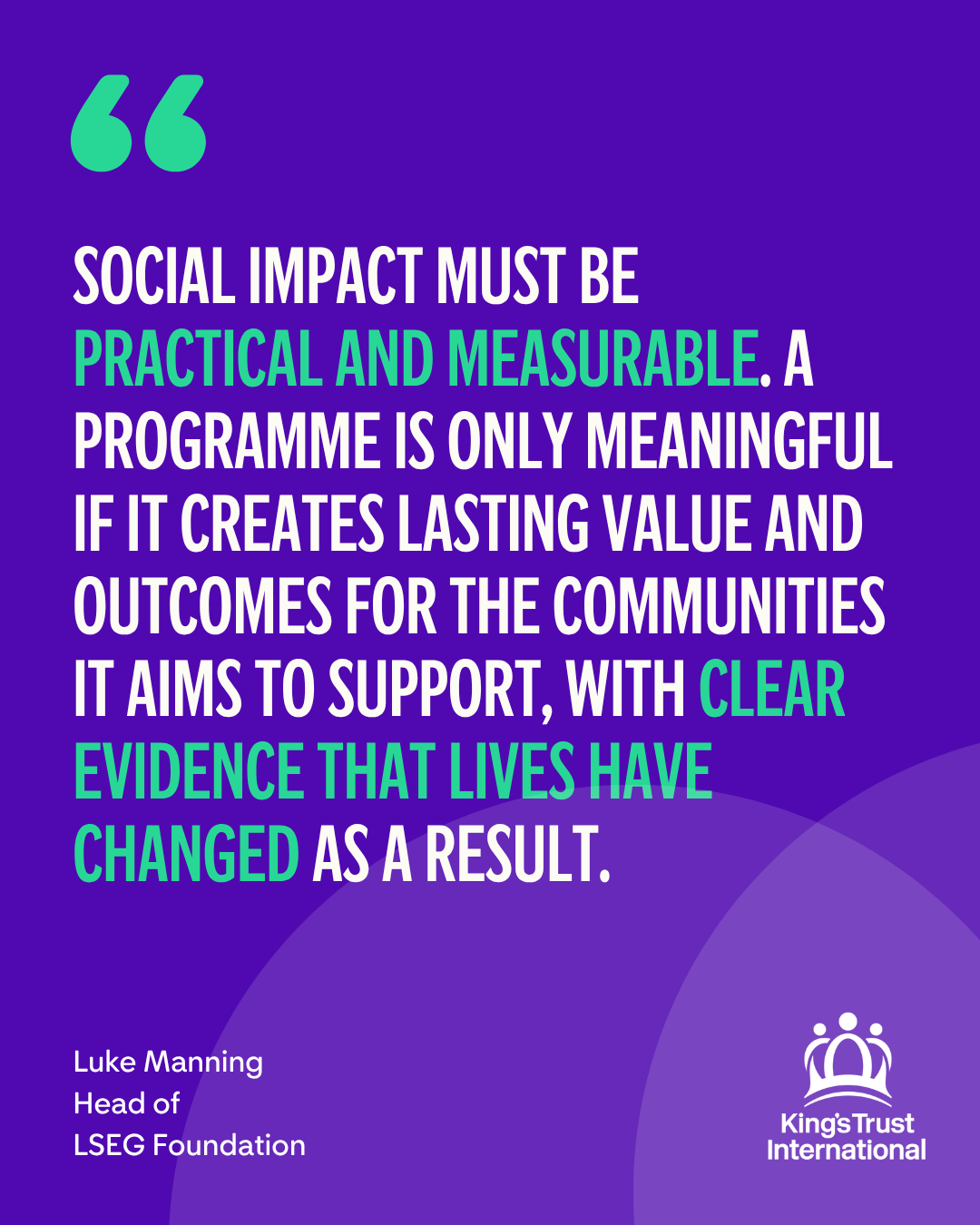
Manning arrives at a similar conclusion, “a programme is only meaningful if it creates lasting value and outcomes for the communities it aims to support, with clear evidence that lives have changed as a result,” he says. The emphasis is on practical, measurable change, particularly in how underserved communities access economic opportunity through education, employment and enterprise.
McConnell brings a more explicitly action-led perspective. “Meaningful social impact works best when it is community-led, rooted in lived experience and focused on solving a problem for good,” she says. At WWT, that thinking is shaped by the role of technology in widening access to opportunity. McConnell points to the importance of feedback and adaptation in ensuring programmes remain relevant: “The question I always ask is whether we are genuinely helping people and how we can learn and adapt based on what they tell us.”
Taken together, the three perspectives point to a shift in emphasis: away from visibility and towards interventions that demonstrate lasting value over time.
"The Problem Is Alignment, Not Talent"
Rapid labour market change is emerging as one of the defining pressures facing young people.
As Zacca notes, “We are operating in a labour market that is evolving faster than traditional systems can respond. The most pressing issue is not a lack of talent, but a misalignment between training, opportunity and employer demand.”
Alongside this structural shift, the organisation highlights changing expectations among younger generations. “Young people are entering the workforce with greater emphasis on purpose, progression and adaptability.”
In practical terms, this is already reshaping what entry into work looks like, particularly in sectors like hospitality, where access alone is no longer enough. The focus is increasingly on structured pathways that allow for progression and long-term careers, rather than short-term entry points.
Manning reflects similar dynamics across financial services and the broader digital economy. “Basic digital literacy is no longer enough. Young people need adaptable, future-facing digital skills and the capability to learn continuously as technology evolves,” he says.
Beyond technical capability, Manning highlights a growing emphasis on softer skills — communication, teamwork, resilience and problem-solving, particularly for young people facing structural barriers to employment. “Young people increasingly expect work to be purpose-driven, flexible and inclusive. Employers that invest in meaningful development pathways and supportive cultures will attract and retain the best talent.”
From a technology sector perspective, McConnell highlights an additional layer: confidence and belonging. “Young people are not just looking for a job anymore. They want purpose, confidence and a sense that they belong in the future we are building,” she says. For WWT, that perspective is shaped by the pace of change across AI, cybersecurity and digital transformation. McConnell argues that employability cannot be reduced to skills alone.
Across these perspectives, employability is increasingly seen as something that cannot be fixed through short-term interventions or skills training alone. It requires alignment between education, employers and opportunity, and sustained partnerships that help bridge that gap in practice, with organisations such as King’s Trust International.
From Funding Relationships to Strategic Collaboration
A clear shift emerging across the CSR landscape is the move away from transactional funding relationships towards more collaborative models of partnership, where corporates play a more active role in shaping outcomes.
For Sandals Foundation, effective programme design depends on specialist expertise and strategic precision. “Maximising impact requires precision,” explains Zacca. “That begins with recognising that effective programme design is increasingly specialised.
This includes areas such as digital transformation, green skills and gender equity, where thematic expertise is essential to ensuring programmes remain relevant and future-facing.
Manning takes a similar view, emphasising that corporates can add value well beyond financial support alone. “Impact through partnership can be maximised by co-creating strategy, rather than simply funding delivery.”
In practice, this is increasingly reflected in advisory group engagement and skills-based volunteering, particularly where corporates bring technical expertise and sector insight into programme design. “Skills-based volunteering can often play an outsized role in embedding impact and provides greater long-term value than financial contributions alone.”
McConnell similarly emphasises partnerships that create value across all sides involved. “Corporate charity partnerships thrive on a win-win-win: meaningful progress for the beneficiary first, for the charity and for the corporate partner.”
Like Manning, McConnell also sees advisory groups as most effective when they help translate intent into action, particularly in areas such as digital skills, green skills and female economic inclusion, where specialist input can meaningfully shape both programme design and corporate decision-making.
Taken together, these perspectives reflect a broader shift in CSR, away from detached philanthropy and towards more integrated partnerships grounded in shared problem-solving, practical expertise and long-term commitment.
What Makes a Partnership Credible
Despite operating in different industries, all three organisations describe credible corporate–NGO partnerships in remarkably similar terms.
For Sandals Foundation, credibility begins with delivery capability and accountability. “We prioritise partners who demonstrate a deep understanding of local contexts, a clear theory of change, and the operational capacity to deliver consistently,” says Zacca. “Strong governance and accountability mechanisms are non-negotiable.”
LSEG Foundation places equal weight on discipline, clarity and measurable outcomes. “We look for organisations with a disciplined operating model, distinct subject matter expertise and reliable measurement systems,” Manning says.
Transparency and open communication sit at the centre of its approach. “The most effective partnerships are those where both sides bring distinctive strengths and communicate openly. We don’t expect perfection, but we do expect transparent, credible data and a two-way dialogue.”
McConnell takes a similar but more explicitly co-creative view. “I look for partners who are determined to solve a problem for good, as well as bring expertise, credibility and a willingness to co-create.” For McConnell, partnerships work best when they move beyond traditional funder–recipient dynamics. “There needs to be a shared problem, mutual accountability and a willingness to change. If only one side is learning, then it is not really a partnership.”
Both Sandals Foundation and WWT emphasise the importance of moving beyond transactional funding relationships towards more collaborative models, combining technical expertise, local knowledge and institutional resources to address complex challenges.
Avoiding Performative CSR
There is a clear and consistent rejection across all three perspectives of performative approaches to corporate social responsibility.
“Avoid fragmentation,” Sandals Foundation advises. “Focus instead on areas where your organisation has both relevance and the capacity to contribute meaningfully. Short-term initiatives rarely produce sustained change,” Zacca concludes. “Impact is built over time.”
LSEG Foundation similarly stresses the importance of clarity and intent from the outset. “Be clear about the social issue you want to help address, the communities you aim to serve and the outcomes you want to see.”
McConnell offers a more direct framing. “Start with one real problem that matters to your business and to the community around you. Don’t begin with the branding. Don’t begin with the optics. Begin with the issue.” Rather than pursuing multiple disconnected initiatives, McConnell argues for depth over breadth, starting small where necessary, but committing for the long term. “Ask what would actually change for communities if this work was done well and stay close to that answer.”
For all three organisations, longevity is fundamental.
From Intent to Accountability
Taken together, the perspectives of Zacca of Sandals Foundation, Manning of the LSEG Foundation and McConnell of WWT point to a clear shift in how corporate social responsibility is being understood.
The emphasis is moving away from isolated initiatives and towards sustained partnerships and outcomes. While each brings a different sector lens, they converge on a shared set of principles: long-term commitment, strategic alignment, shared learning and a focus on solving real-world problems.
Within that shift, organisations like King’s Trust International play an increasingly important role in helping corporates translate ambition into locally grounded, evidence-led programmes that create tangible opportunities for young people.
The central message from corporate leaders is consistent: credible CSR is no longer defined by what organisations say about impact, but by what they do, the partnerships they build and the change they can demonstrate over time.
As McConnell reflects, “Perhaps the difference we make is the action we take.”